Walk-In Cold Room Buying Guide: Types, Sizes & Costs
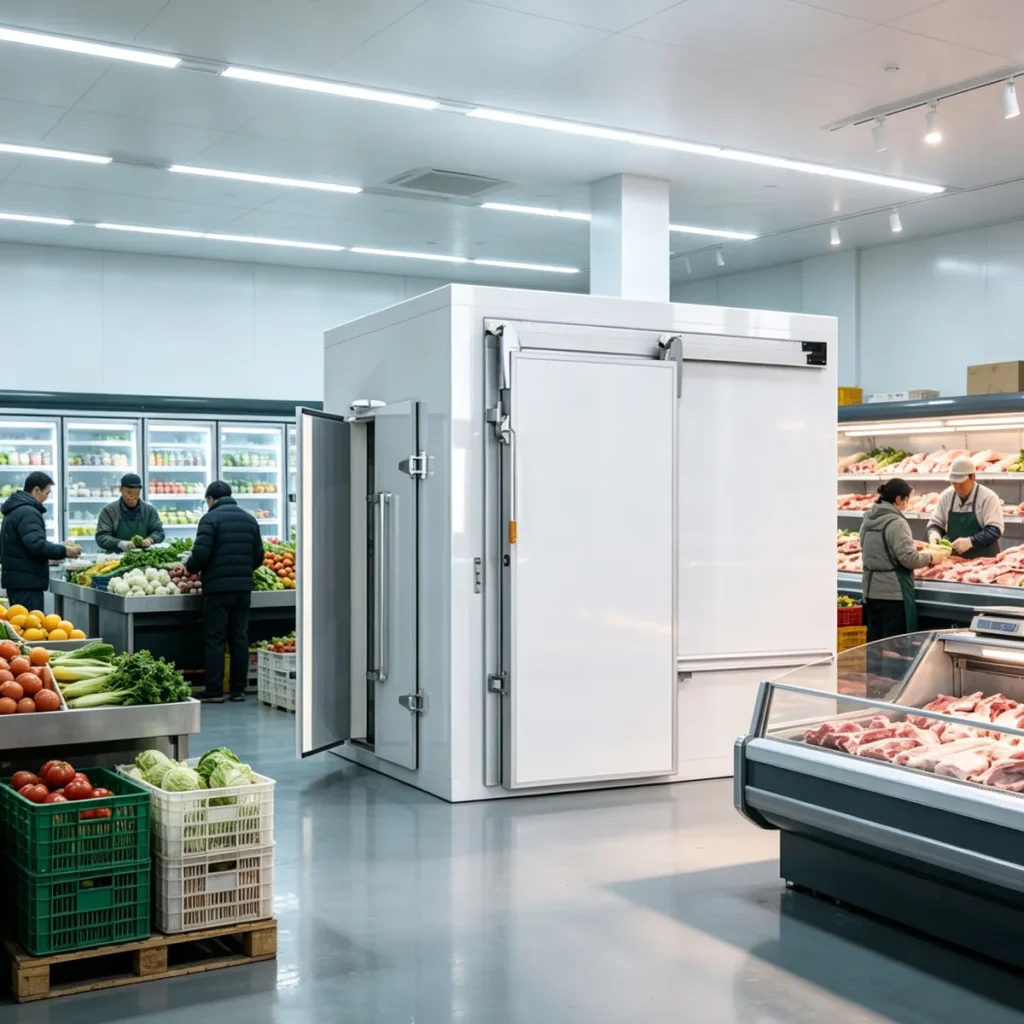
When display chillers and upright freezers can no longer hold your stock, a walk-in cold room is usually the next step. It gives supermarkets, restaurants, meat and seafood traders and produce businesses far more storage at a lower cost per cubic metre. It also keeps products at a stable temperature from delivery to sale.
But a walk-in cold room is a project, not a box you pick off a shelf. Size, temperature, insulation, the refrigeration unit and the local climate all affect how well it works and how much it costs to run.
This walk-in cold room buying guide explains the main types, how to size a room and which components to check. It also covers what to consider in hot climates and off-grid locations, what drives the price, and how to choose a cold room manufacturer you can rely on.
What Is a Walk-In Cold Room and Who Needs One?
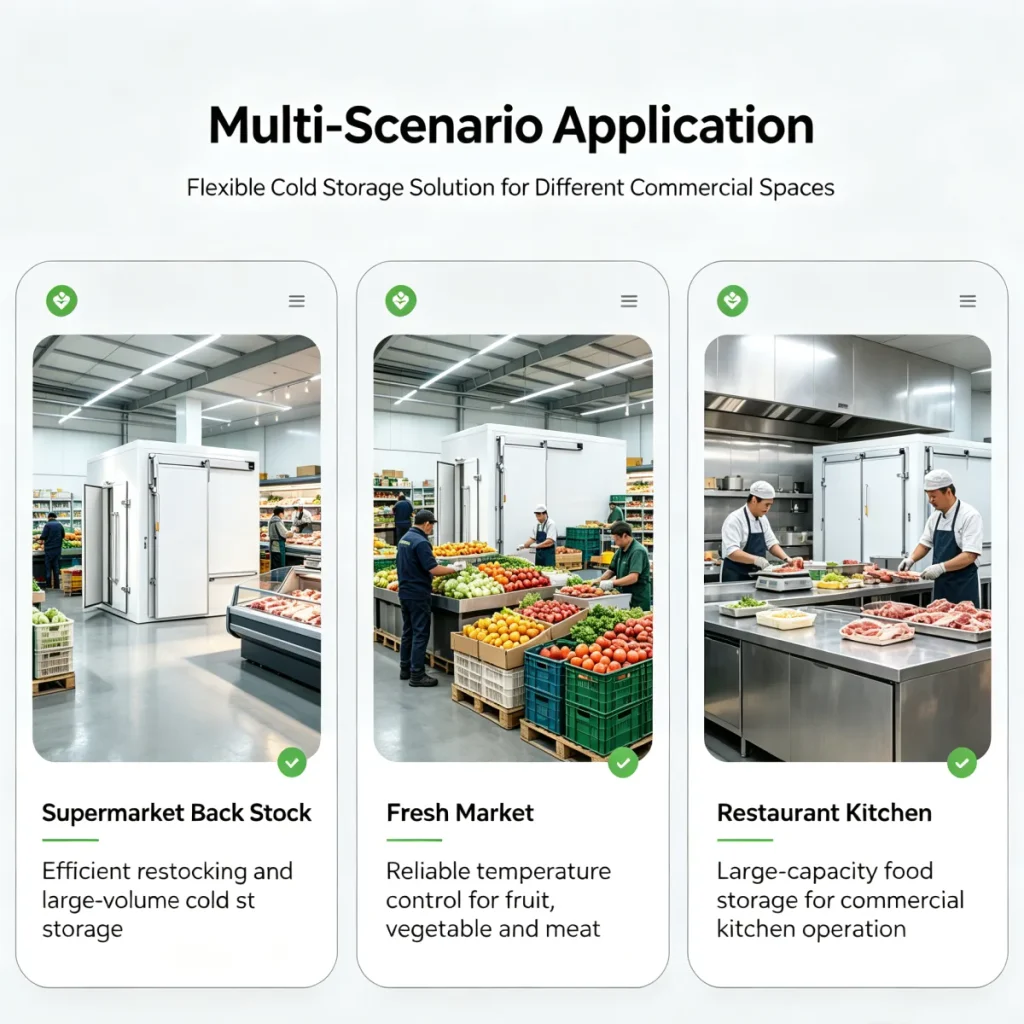
A walk-in cold room is an insulated room built from prefabricated panels, cooled by a refrigeration system and large enough for staff to walk inside. Products are stored on shelves, racks or pallets, and the room can be set up as a chiller or a freezer.
Common users include:
- Supermarkets and grocery stores, for back-of-house storage of dairy, beverages, meat and frozen food.
- Restaurants, hotels and catering kitchens, for daily ingredients and prepared food.
- Butchers and seafood traders, who need steady low temperatures for fresh and frozen products.
- Fruit and vegetable wholesalers, farms and cooperatives, to extend shelf life after harvest.
- Beverage and ice cream distributors, for stock between deliveries.
Compared with a row of upright freezers, one walk-in cold room uses floor space more efficiently and is easier to load and organise. It also usually costs less to run for every cubic metre of product stored.
Types of Walk-In Cold Rooms
Walk-in cold rooms are usually grouped in three ways: by temperature, by refrigeration system and by where they are installed.
By temperature
- Chiller room (about 0°C to +10°C): fruit, vegetables, dairy, drinks, fresh meat and ready meals.
- Freezer room (about −18°C or lower): frozen meat, fish, ice cream and frozen vegetables.
- Dual-temperature room: one structure divided into a chiller section and a freezer section, each with its own refrigeration unit. It is a practical choice for supermarkets and restaurants with limited space.
For very fast freezing of freshly cooked or freshly caught products, a blast freezer is used first, before products move into the freezer room.
By refrigeration system
- Monoblock (plug-in) unit: the whole refrigeration system sits in one box mounted on the wall or roof of the room. Installation is simple, and no refrigerant piping is needed on site. It is best for small and medium rooms.
- Split system: a condensing unit outside and an evaporator inside, connected by refrigerant pipes. It suits larger rooms and keeps heat and noise outside. Installation needs a qualified refrigeration technician.
By installation
- Indoor cold rooms sit inside a warehouse, shop or kitchen, protected from sun and rain.
- Outdoor cold rooms need a roof or weatherproof cover, UV-resistant panel surfaces and careful sealing. Container-based cold rooms are another option if you need a movable, self-contained unit.
How to Size Your Walk-In Cold Room
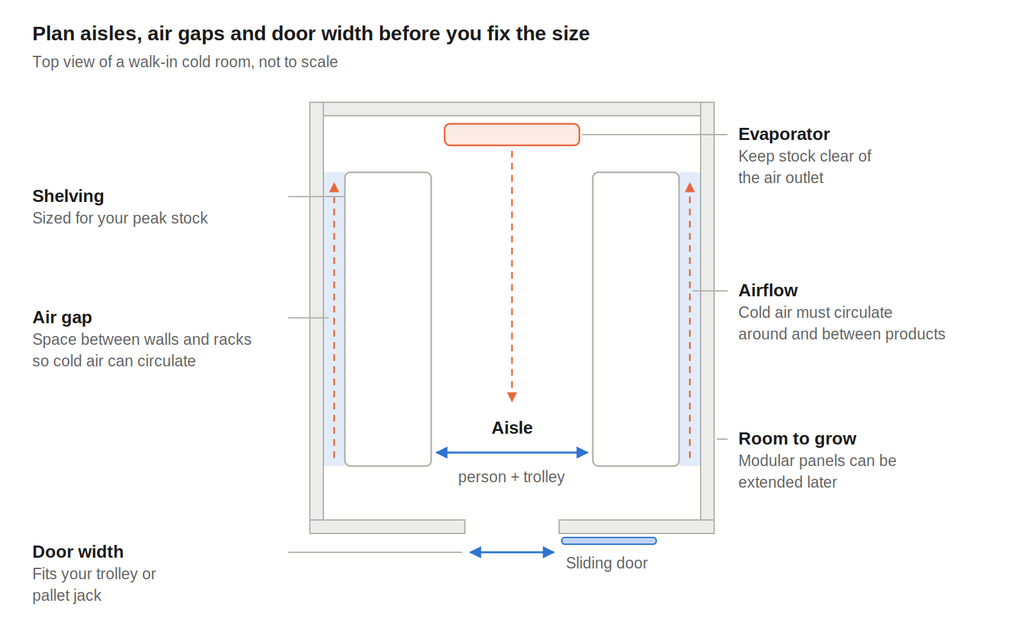
A room that is too small forces you to overload shelves and block airflow. A room that is too big wastes energy cooling empty space. Work through these points before you ask for a quote:
- Estimate your peak stock. Base the size on your busiest period, such as the days before a holiday or after a large delivery, not an average week.
- Leave space for airflow. Cold air must circulate around and between products. Keep stock away from the evaporator and leave gaps between walls and racks.
- Plan aisles and doors. Aisles should fit a person with a trolley. If you move pallets, the door width must suit your pallet jack.
- Check the ceiling height of the building, including space above the room for the refrigeration unit if it is roof-mounted.
- Think about growth. Modular panels can usually be extended later, but planning a little extra space now costs less than rebuilding.
The table below gives example sizes and their typical uses. Volumes are gross external volumes, so usable space inside is somewhat smaller.
| Example size (L × W × H) | Gross volume | Typical use |
|---|---|---|
| 2 × 2 × 2.2 m | about 9 m³ | Small restaurant or shop |
| 3 × 2.5 × 2.4 m | about 18 m³ | Busy restaurant, convenience store |
| 4 × 3 × 2.6 m | about 31 m³ | Supermarket back room, butcher |
| 6 × 4 × 3 m | about 72 m³ | Large supermarket, wholesaler, produce collection point |
A good cold room manufacturer will check these figures against your product list and recommend a size and refrigeration capacity that fit.
Key Components to Check
Two cold rooms of the same size can perform very differently. These components make the difference.
Insulation panels
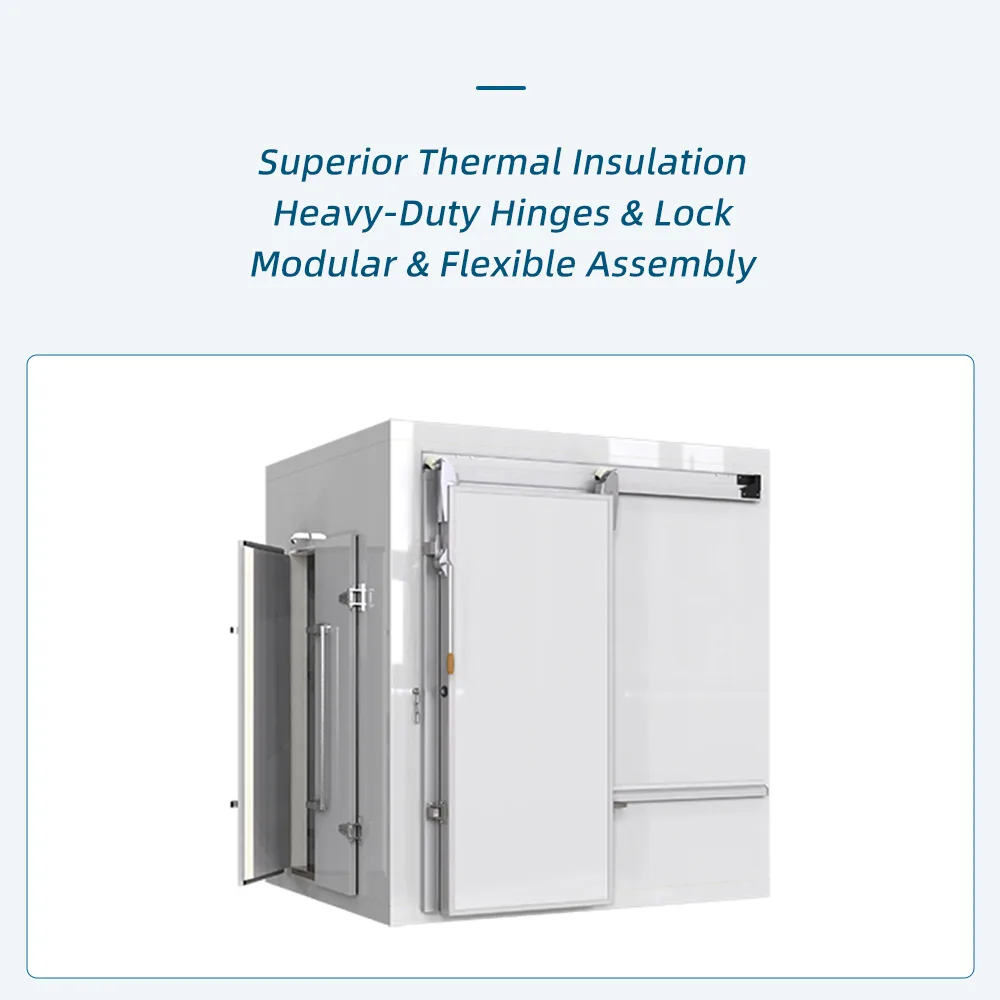
Most walk-in cold rooms use sandwich panels with a high-density polyurethane (PU) foam core between two steel sheets. Ask about foam density and panel thickness, because thicker, denser panels let in less heat.
As a general guide, 50mm panels suit small indoor rooms at mild chiller temperatures. Most chiller rooms use 75–100mm, while freezer rooms need 100mm or more, especially in hot climates. Cam-lock joints pull panels tightly together, which improves sealing and speeds up on-site assembly. For the inner surface, choose a food-grade, waterproof finish that is easy to clean.
Refrigeration unit and compressor
The refrigeration capacity must match the room volume, the target temperature, how often the door opens, the temperature of incoming products and the outside temperature. Ask the supplier to show how they calculated the capacity, and which compressor brand and refrigerant they use.
Evaporator and defrost
In freezer rooms, ice builds up on the evaporator coil. Automatic defrost, with electric heaters or hot gas, keeps the coil clear. The drain line must also be heated so meltwater does not freeze.
Doors and curtains
Hinged doors suit small rooms. Sliding doors save space and allow wider openings for pallets. A side access door is handy for small daily loads without opening the main door. Freezer doors need a heated frame so the gasket does not freeze shut. Every door should have an inside safety release, and strip curtains reduce cold loss during loading.
Floor
Freezer rooms need insulated floor panels or an insulated concrete floor, plus protection against frost heave in large rooms. Chiller rooms can sometimes stand on an existing concrete floor.
Controller and alarm
A digital controller sets temperature and defrost cycles. Add a high-temperature alarm, and consider data logging or remote monitoring if you store high-value or regulated products.
Walk-In Cold Rooms for Hot Climates
In the Middle East, Africa and Southeast Asia, outdoor temperatures of 35–45°C put extra load on every part of a cold room. A room designed for a mild European climate can struggle here. These steps keep performance stable:
- Choose a refrigeration unit rated for high ambient temperatures. Ask the supplier to size the unit for your hottest month, not an average day.
- Give the condensing unit shade and free airflow. A condenser in direct sun or a closed corner loses capacity quickly. Keep at least the clearance the manufacturer specifies on all sides.
- Use thicker panels. Moving up one panel thickness costs little compared with years of extra electricity.
- Protect outdoor rooms from the sun. A roof or shade structure over the cold room reduces heat gain through the ceiling, which takes the most sun.
- Control door openings. Strip curtains, a side access door for small loads and staff training all reduce warm air entering the room.
- Protect against power problems. Where voltage drops are common, use a voltage protector or stabilizer. A backup generator and a temperature alarm protect stock during long outages.
The same principles apply to all refrigeration equipment. Our guide on how to choose a commercial refrigeration manufacturer in China covers hot-climate checks for display chillers and freezers as well.
Solar Cold Rooms and Off-Grid Cooling: What to Consider
In many rural parts of Africa and Southeast Asia, the grid is unreliable or absent, yet farmers and traders lose a large share of fresh produce after harvest. A solar cold room uses photovoltaic (PV) panels to power the refrigeration system. Some designs add batteries or thermal storage, such as ice or phase-change material, to keep the room cold at night.
Before choosing a solar cold room, think through these points:
- Daily cooling load. How much product enters the room each day, and how warm is it? Produce straight from the field needs far more energy than goods that are already chilled.
- Energy storage. Batteries add cost and need replacing after some years. Thermal storage is often cheaper to maintain but needs careful design.
- Space for the PV array. The panels need open ground or a strong roof with full sun.
- Insulation quality. Every watt of heat kept out reduces the size of the solar system you need, so thicker panels and good door seals pay off even more.
- Hybrid power. Combining solar with the grid or a generator often gives the best balance between cost and reliability.
- Local support. Make sure someone nearby can service the refrigeration system and the electrical components.
For a detailed technical reference, see Walk-In Cold Rooms: A Practitioner’s Technical Guide, produced by the International Institute of Refrigeration and Efficiency for Access. It covers cold rooms in hot climates and in off-grid and weak-grid locations.
If your site has limited power, tell us about it when you ask for a quote. Thicker panels and an efficient refrigeration unit reduce the energy a cold room needs, whatever the power source.
What Affects the Price of a Cold Storage Room?
If you compare cold storage rooms for sale online, prices can look very different for rooms that seem similar. These are the main factors behind the difference:
- Size. Larger rooms need more panels and more refrigeration capacity, although the cost per cubic metre usually falls as size grows.
- Temperature. A freezer room costs more than a chiller room of the same size. It needs thicker panels, a bigger refrigeration unit, an insulated floor, defrost and a heated door frame.
- Panels. Thickness, foam density and surface material (coated steel or stainless steel) all affect the price.
- Refrigeration unit. Monoblock or split system, compressor brand and capacity.
- Doors. The number of doors, hinged or sliding, and extras such as a side access door or viewing window.
- Accessories. Shelving, strip curtains, lighting, alarms and remote monitoring.
- Installation, shipping and import duties. These vary by country and should be part of your total budget.
As a reference, ICETRANS standard modular walk-in cold rooms are listed at US$5,000–6,000 per unit, with a minimum order of one unit. The final price depends on the size, temperature and options you choose.
When you compare quotes, make sure they are on the same basis: the same panel thickness, the same refrigeration capacity and the same list of included items. The cheapest cold storage room for sale is not always the cheapest to own once you add electricity and repairs.
How to Choose a Cold Room Manufacturer
A walk-in cold room only works as well as its design and installation. When you compare suppliers, look for a cold room manufacturer that can show the following:
- Design support. They ask about your products, daily volumes and climate, then recommend a size, panel thickness and refrigeration capacity, rather than just quoting a standard box.
- In-house panel production. Manufacturers that make their own panels control foam density, thickness and quality.
- A complete package. Panels, doors, refrigeration unit, controller and accessories from one source, tested to work together.
- Installation support. Clear assembly drawings, a manual and video guidance, plus remote help during installation and commissioning.
- Spare parts and after-sales service. Ask which parts they can ship quickly and how they handle problems after delivery.
- Export experience. A cold room manufacturer that ships regularly to your region understands packing, documents and local conditions.
Ask for photos or videos of finished projects in climates like yours. They tell you more than any brochure.
Why Choose ICETRANS Walk-In Cold Rooms
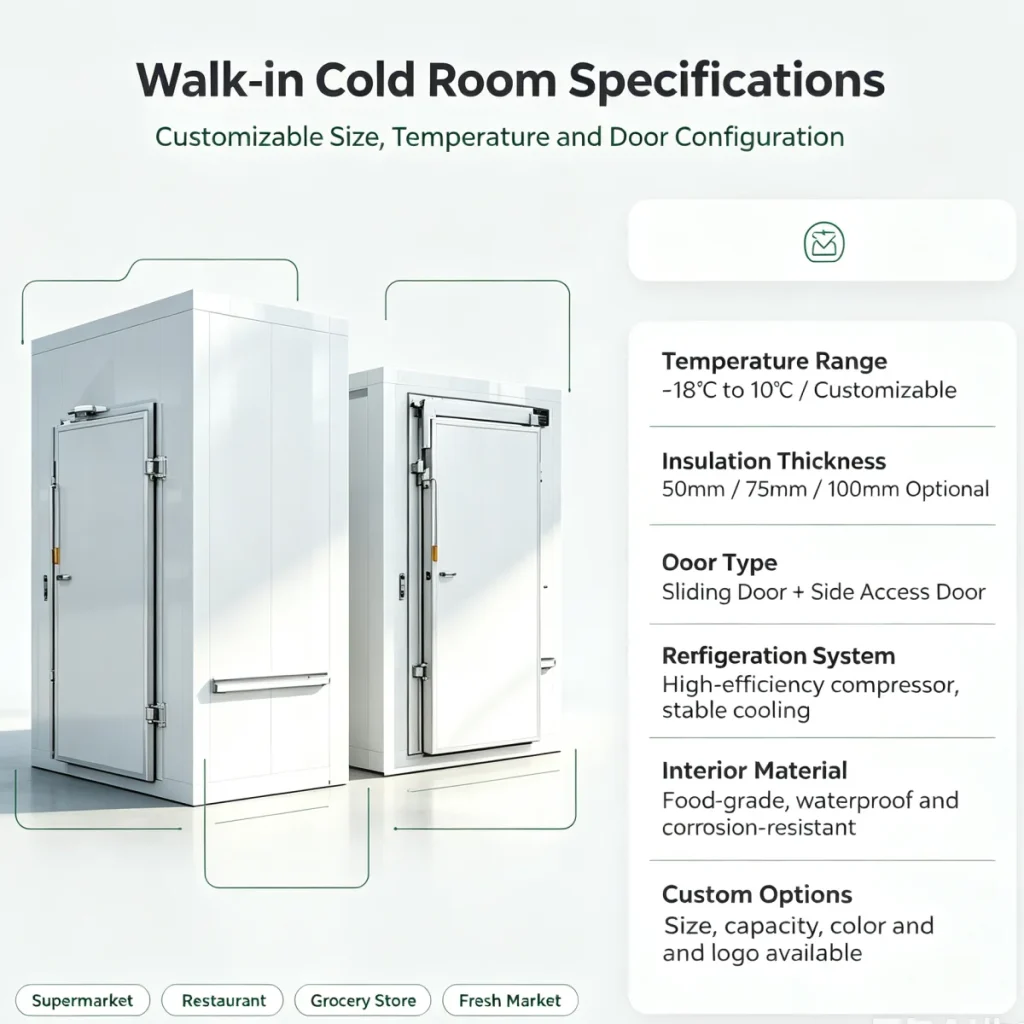
ICETRANS designs and builds walk-in cold rooms for supermarkets, restaurants, grocery stores, fresh markets and food distributors. Our standard models include:
- An industrial walk-in cold room for fresh and frozen food, suitable for meat, seafood and bulk storage.
- A modular walk-in cold storage room for food retail, restaurants and catering.
Both share the same core features:
- Temperature range from −18°C to +10°C, with custom settings available.
- High-density PU insulation panels in 50mm, 75mm or 100mm thickness.
- Modular panel design for quick on-site assembly.
- A space-saving sliding main door plus a side access door for daily loading.
- Food-grade, waterproof and corrosion-resistant interior that is easy to clean.
- Custom size, capacity, colour and logo.
You can order from a single unit. Get a quote with your required size, temperature and destination, and our team will recommend the right configuration for your products and climate.
Frequently Asked Questions
What temperature can a walk-in cold room reach?
Our standard walk-in cold rooms work from −18°C to +10°C, which covers both chiller and freezer storage. Custom temperature settings are available on request.
Which panel thickness should I choose?
It depends on the room temperature and your climate. As a guide, 50mm suits small indoor chiller rooms, 75–100mm suits most chiller rooms, and freezer rooms should use 100mm panels.
Can a walk-in cold room be installed outdoors?
Yes, as long as it has a roof or shade cover and good sealing against rain and sun. Tell us about your site, and we will recommend the right panels and refrigeration unit.
How is a modular cold room installed?
The panels arrive flat-packed and are joined on site. The doors and refrigeration unit are then fitted, and the system is tested before you load products. We provide drawings and guidance to support your installer.
Can I order just one cold room?
Yes. The minimum order is one unit, so you can start with a single room and add more later.
Can the cold room be customized?
Yes. Size, capacity, temperature, colour and logo can all be adjusted to your needs.