Commercial Refrigeration Manufacturer China: Buyer’s Guide
Buying refrigeration equipment for a supermarket, convenience store or distribution business is a long-term decision. A display chiller that struggles in 40°C heat, or a freezer whose compressor fails in its second summer, costs far more than the money saved on the order. That is why choosing the right commercial refrigeration manufacturer in China matters as much as choosing the right model.
China produces a large share of the world’s commercial refrigerators, freezers and cold rooms, so buyers have plenty of choice. The real challenge is telling a capable factory from a seller that only looks good on paper.
This guide is written for supermarket owners, equipment distributors and importers in Southeast Asia, the Middle East and Africa. It covers the difference between manufacturers and trading companies, eight checks to make before you order, an equipment checklist for a new store, the sourcing process step by step, and the red flags to watch for.
Why Buyers in Southeast Asia, the Middle East and Africa Source from China
For most buyers in these regions, China offers a combination that is hard to find anywhere else.
Lower cost. Factories in Guangdong and other manufacturing provinces have mature supply chains for compressors, glass doors, copper tubing and insulation panels. Volume production keeps unit costs well below those of European or North American brands.
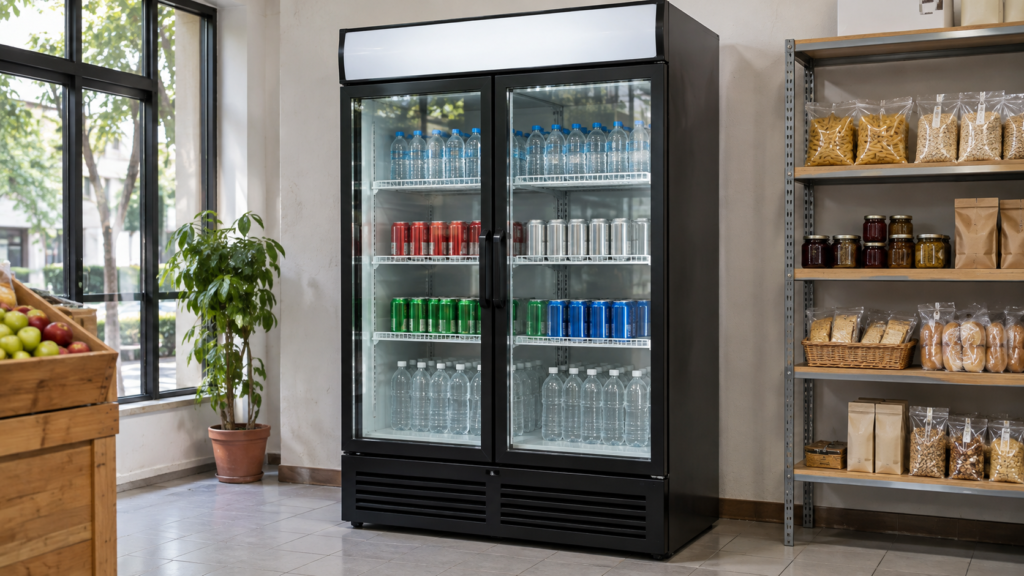
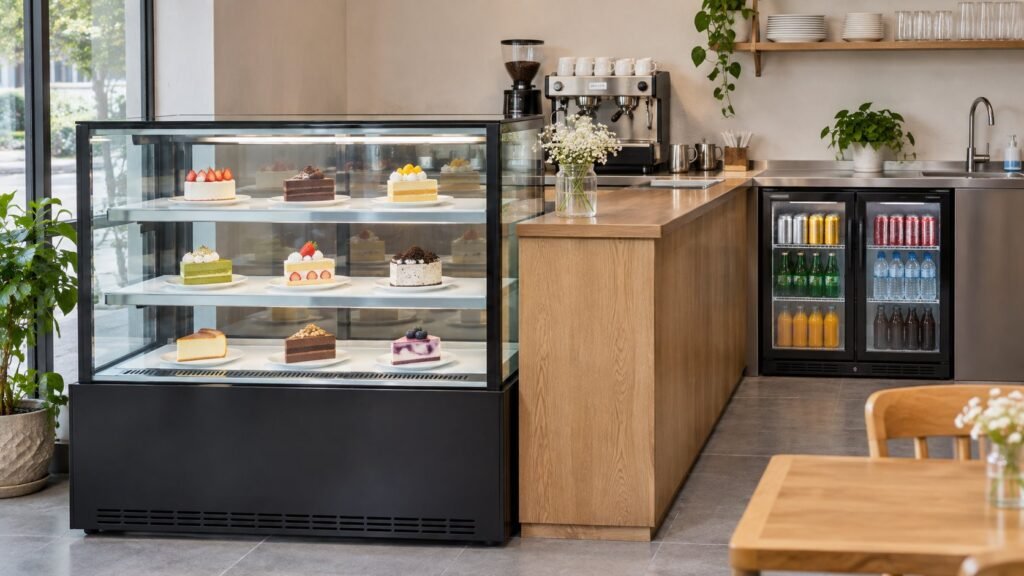
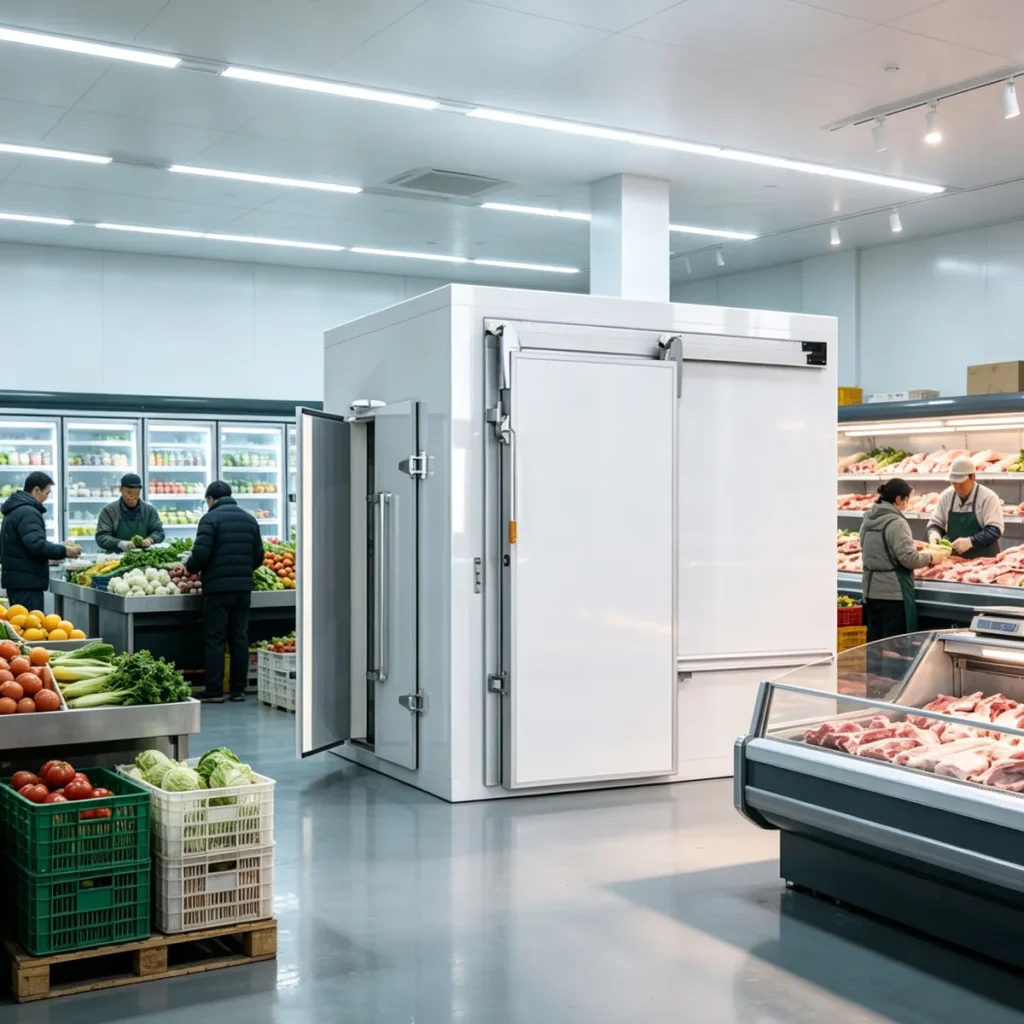
A complete product range. One factory can often supply display chillers, display freezers, multideck chillers, meat counters, kitchen refrigeration and cold rooms. That makes it possible to equip a whole store from a single source and ship everything in one container.
Customization. Chinese manufacturers are used to adjusting voltage, plug type, dimensions, colours and branding for export markets. For distributors building their own brand, OEM production is a standard service, not a special request.
Export experience. Many factories ship regularly to Asia, the Gulf and Africa. They understand export documents, packaging for long sea freight and the conditions their equipment will face on arrival.
The trade-off is that quality varies widely from one supplier to the next. The rest of this guide explains how to find the good ones.
Manufacturer vs. Trading Company vs. Supplier: What’s the Difference?
When you search for a commercial refrigerator supplier, you will find three kinds of sellers, and online they are not always easy to tell apart.
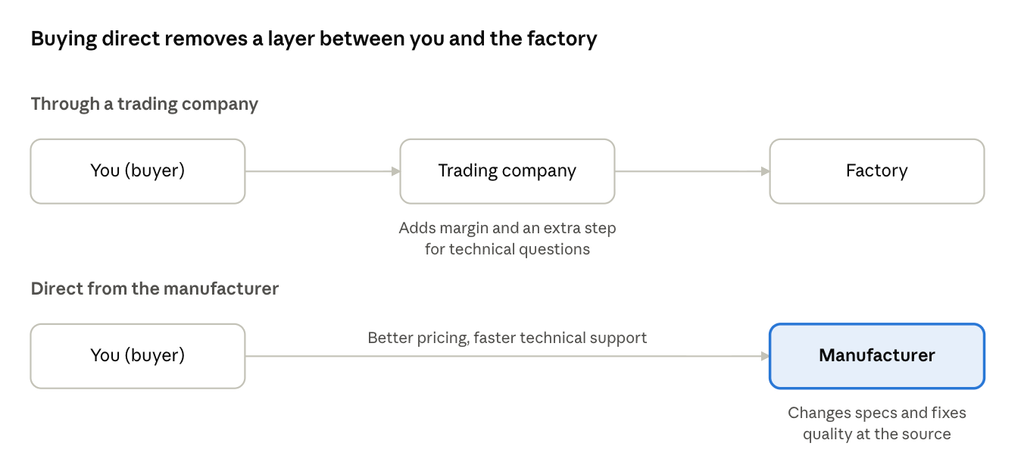
Manufacturers own the factory. They control the production line, foaming, assembly and testing. They can change specifications, fix quality problems at the source and quote directly, without a middle margin.
Trading companies buy from one or several factories and resell. A good trader can be useful if you need many unrelated products in one shipment. But it adds cost and an extra layer between you and the people building your equipment. Technical questions take longer to answer, and customization is limited to what its factories agree to.
Supplier is a broad term that covers both. Some trading companies describe themselves as manufacturers, so it pays to check.
[embed: node/5d7d6bdd-2af4]
Every extra layer between you and the factory adds cost and slows down answers to technical questions.
How to check whether a commercial refrigerator supplier really owns a factory:
- Ask for the factory address and compare it with the business licence.
- Request a live video tour of the production line, not only edited promotional videos.
- Ask detailed technical questions about insulation thickness, compressor selection or refrigerant charge. Factory engineers answer these quickly and precisely.
- Look at how focused the product range is. A factory usually specializes in one family of related products. A seller offering refrigerators, furniture and LED lights is most likely a trader.
Buying directly from the manufacturer usually gives you better pricing, faster technical support and more control over quality.
8 Things to Check Before Choosing a Commercial Refrigeration Manufacturer in China
Price is easy to compare. These eight points are what separate a reliable partner from a risky one.
1. A product range that covers your whole store
If you are opening or upgrading a supermarket, working with one supermarket refrigeration equipment supplier for every section makes life simpler: one quotation, one quality standard, one shipment and one after-sales contact. Check whether the factory can supply display chillers, display freezers, multideck display chillers, meat display counters, walk-in cold rooms and ice makers in matching styles. You can browse our full product range to see how the categories fit together.
2. Performance in hot climates
For buyers in hot regions, this is the most important technical check. Refrigeration units are tested at a set room temperature and humidity. A unit tested at 25°C may struggle in a shop that reaches 35°C or more in the afternoon.
Ask the manufacturer what conditions each model was tested at. For display cabinets, ISO 23953 climate class 5 means testing at 40°C. For upright refrigerators, climate class T covers rooms up to 43°C. Also ask about condenser size and airflow, because an undersized condenser is the most common cause of poor performance in the heat.
3. Voltage, frequency and power stability
Most markets in these regions use 220–240V, but the frequency differs. Saudi Arabia and the Philippines, for example, use 60Hz, while most other countries use 50Hz. A compressor built for the wrong frequency will run inefficiently or fail early, so confirm this in writing.
Where voltage drops and power cuts are common, ask about wide-voltage compressors, built-in voltage protection or an external stabilizer. For off-grid shops, ask whether the factory offers DC or solar-powered models.
4. Compressors and refrigerants
The compressor is the heart of the unit. Ask which compressor brands are used and whether you can choose between options. Established brands come with their own warranty and spare-parts networks.
Refrigerant matters too. R290 (propane) has a very low global warming potential and good efficiency, and it is becoming the standard for plug-in commercial units in many markets. R134a and R404A are still common but face phase-down rules in more and more countries. Check what your local regulations allow before you order.
5. Certifications for your market
Ask for copies of certificates, not just logos on a website. CE and ISO 9001 are common baselines. Then check your own market’s import rules, such as SASO conformity through the SABER platform in Saudi Arabia, ECAS in the UAE, SONCAP in Nigeria or the PVoC programme in Kenya. These requirements change, so confirm the details with your customs broker. An experienced exporter will know these schemes and can supply the product documents they need.
6. OEM/ODM capability
For distributors, an OEM refrigerator manufacturer can put your brand on the product, from the logo on the cabinet to the control panel, packaging and manual. ODM goes a step further and adapts the design itself: size, shelf layout, door type, lighting or colour. Ask how many OEM projects the factory has completed and what the minimum order is for custom branding. Our OEM/ODM service page shows what is possible.
7. Packaging, container loading and lead time
Refrigeration equipment spends weeks at sea and is moved several times before it reaches your store. Ask how units are packed, for example with wooden frames, foam corners and stretch film. Ask how many units fit in a 20GP or 40HQ container, so you can calculate the landed cost per unit. Confirm the production lead time in the contract, especially before peak seasons such as summer or Ramadan.
8. After-sales service and spare parts
Even good equipment needs parts eventually. Ask what the warranty covers and for how long, whether spare parts can ship with the order, and how quickly the factory responds to a technical problem. A set of common wearing parts in each shipment can save distributors far from China weeks of downtime.
Supermarket Refrigeration Equipment Checklist
Planning a new store or a renovation? Use this checklist to make sure your quotation covers every area. A full-range supermarket refrigeration equipment supplier can quote all of these together.
| Store area | Equipment | What to check |
|---|---|---|
| Beverages and dairy | Glass door display chiller, multideck display chiller | Door type, number of shelves, LED lighting, night curtain |
| Frozen food | Island freezer, glass door freezer, chest display freezer | Temperature range, defrost type, lid or door design |
| Fresh meat and fish | Meat display counter, serve-over counter | Humidity control, temperature stability, glass shape |
| Fruit and vegetables | Open multideck chiller | Air curtain performance, misting option |
| Ice cream and desserts | Ice cream display freezer, gelato showcase | Low-temperature range, product visibility |
| Bagged ice | Ice merchandiser, ice maker | Daily ice output, storage volume |
| Back of house | Walk-in cold room, blast freezer | Panel thickness, condensing unit size, door type |
| Deli and food service | Salad prep table, undercounter refrigerator | Stainless steel grade, pan sizes |
Before you send an inquiry, list the number of units you need in each area and share the store’s floor plan. This helps the manufacturer recommend the right models and avoid gaps or overlaps.
Planning back-of-house cold storage as well? Our walk-in cold room buying guide covers sizes, panels and costs in detail.
The Sourcing Process, Step by Step
A typical order from a commercial refrigeration manufacturer in China follows these steps.
- Send your inquiry. Include product types, quantities, destination port, voltage and frequency, and any certification requirements.
- Confirm specifications. The factory replies with model recommendations, drawings and technical data. Clarify dimensions, temperature range, refrigerant and compressor.
- Review the quotation. Check the price terms (FOB, CIF or others), payment terms, lead time and warranty.
- Order samples (optional). For a new supplier or a new OEM design, a sample order lets you test performance in your own climate before committing to volume.
- Sign the proforma invoice and pay the deposit. Make sure every agreed specification is written into the proforma invoice or contract.
- Production. Ask for photo or video updates at key stages, such as foaming, assembly and performance testing.
- Inspection. Inspect before shipment, in person, through a third-party inspection company or by live video. Check appearance, temperature performance and labelling.
- Shipping and documents. The factory arranges loading and provides the commercial invoice, packing list, bill of lading and any certificates your customs require.
- After delivery. Keep in touch about installation, spare parts and feedback for your next order.
Red Flags to Watch Out For
If you notice any of these warning signs, slow down and ask more questions before you pay.
- A price far below the market. It usually means thinner insulation, a smaller compressor or cheaper glass.
- Vague specifications. If a seller cannot tell you the compressor brand, refrigerant or test conditions, be careful.
- No factory evidence. No live video, no address that matches the business licence, only stock photos.
- Certificates that cannot be checked. Ask for the certificate number and verify it with the issuing body.
- Pressure to pay everything upfront. Standard terms are a deposit before production and the balance before shipment or against documents.
- Slow or evasive answers. If it is hard to get clear answers before you pay, it will be harder after.
Why Work with ICETRANS
ICETRANS is a commercial refrigeration manufacturer in Shunde, Foshan, in China’s Guangdong Province, with more than 10 years of experience in refrigeration equipment. We supply supermarkets, distributors and food-service businesses with a complete range of equipment: display chillers and freezers, multideck chillers, meat display counters, ice cream display freezers, ice makers, slush machines, kitchen refrigeration and walk-in cold rooms.
As a factory, we can adapt voltage, frequency, size and design to your market, and we offer full OEM/ODM service for distributors who want to sell under their own brand. Ask our team about the certificates and product documents available for your country.
Planning a new store or looking for a long-term supplier? Get a quote with your product list and destination port, and our team will recommend the right models for your market and climate.
Frequently Asked Questions
What is the minimum order quantity?
MOQ depends on the product and on whether you need OEM branding. Standard models can often be mixed in one container. Contact us with your product list for the exact MOQ.
How long is the production lead time?
Lead time depends on the model, the quantity, the level of customization and the season. We confirm it in the quotation before you place an order.
Can I put my own brand on the equipment?
Yes. As an OEM refrigerator manufacturer, we can add your logo to the cabinet, control panel and packaging, and develop custom designs through our ODM service.
Can the equipment run on 60Hz power?
Tell us your destination country, and we will confirm the correct voltage, frequency and compressor for your market before production.
Is your equipment suitable for hot and humid climates?
Share your typical shop temperature and humidity, and we will recommend models designed and tested for high ambient conditions.
What warranty do you offer?
Warranty terms vary by product. We state them clearly in each quotation, together with the spare parts available.